

Originally published 1 June 2008.
Last updated on 9 October 2025, and will be undergoing a much-needed content upgrade quite soon!
Includes a short history of Chinese dragons along with a summary of famous Chinese dragons.
Chinese Dragons History
Introduction
Physiology
Types
Maturation
Chinese Dragon & Pearl
Chinese Dragon Bones
Ancient China
Dragon Colors & Meaning
Elemental Dragon Types
Conclusion
Famous Chinese Dragons
Dragons are deeply rooted in Chinese culture. The Chinese sign for the dragon first appeared upon turtle shields as a tribal totem way back during the Yin and Shang dynasties, and was eventually emblazed on the national flag during the Qing Dynasty [1644-1911 AD].
Chinese mythology is rich with the artwork, tales and depictions of dragons. Dragons are thought to give life, hence their breath is called “sheng chi” or divine energy. They are essentially benevolent and associated with abundance and blessing. They were helpful, wise and generous with their gifts when people encountered them.

The Rising Celestial Dragon. Details of a mandarin robe of embroidered silk, Chia-ching period (1796-1820), Qing Dynasty.
Known as the sons of heaven and the governors of rainfall, they symbolise royalty, nobility and good fortune. Some possessed great powers that allowed them to make rain and control floods, hence the dragon is a symbol of the natural world as well.
Learn more about Asian Dragons in our series:
> Chinese | Japanese | Korean | Vietnamese
Physiology of Chinese Dragons
Wang Fu [Han dynasty 206 BC – AD 220], was the scholar who recorded the anatomy of the Chinese dragon in extensive detail. Chinese dragons have nine characteristics which are a complex combination. They have a camel’s head, a demon’s eyes, a cow’s ears, a deer’s horns, a clam’s belly, a snake’s neck, an eagle’s claws, a tiger’s paws and 117 carp scales.
Chinese dragons are physically concise. Of the 117 scales, 81 are of the yang essence [positive] while 36 are of the yin essence [negative]. This malevolent influence [which is thankfully the smaller ratio] accounts for their destructive and aggressive side. Just as water destroys, so can the dragons in the form of floods or droughts, tidal waves and storms. Legend has it that they caused the droughts by eclipsing the sun. Some of the worst floods were believed to have been the result of a mortal upsetting a dragon.
Number of Toes / Claws
Update (Oct 2025): In Chinese imperial tradition, the number of claws on a dragon’s foot signified rank and reverence. This symbolism echoes across East Asian dragon lore, revealing fascinating regional distinctions.
In East Asian dragon lore, the number of claws on a dragon’s foot often reflects regional artistic traditions and imperial symbolism. Chinese imperial dragons were depicted with five claws—a sacred number reserved for the emperor. Commoners and non-imperial dragons typically bore four claws, a distinction that was once legally enforced.
Korean dragons are most often shown with four claws, and many Japanese dragons are typically portrayed with three claws.
For a comparative look at claw count in Korean and Japanese dragon myths, see: Korean Dragons | Japanese Dragons
References: Classroom, OnmarkProductions
###
* UPDATE (Jan 2012): I received an insightful email from a visitor to Dragonsinn.net (re: Eastern dragons and the number of toes). Email is pasted below 🙂 — take note!
“Hi! I’ve enjoyed glancing through your very comprehensive dragon site. However, I would like to suggest one small correction. Any sources that say ALL Chinese dragons have five toes are mistaken. Only the
The photo of the Jingdezhen plate [blue/white picture below] on your Chinese dragons page is proof of this. Unfortunately, today, many Chinese people are unaware of this traditional distinction and modern depictions of five toed dragons are common. In the same way, many Japanese do not know that Japanese dragons should only have three toes and so you can easily find modern paintings and illustrations of dragons here with five toes. It’s very frustrating for a traditionalist like me!”
~ Respectfully, R.S. (Kyoto, Japan) | 25 Dec 2011
* Jess’s Original Note (pre-2012): Some sources say that Imperial Dragons are the only dragons with five claws/toes, others say that all Chinese dragons have five toes. I guess it’s because the Chinese believe that Eastern dragons originated from China. They believed that when the dragons flew away, they began to lose their toes. The further the dragons flew, the more toes they lost. That is why Korean dragons have four toes, and Japanese dragons have three.
Nine Types of Classical Chinese Dragons
There are a total of nine types of classical Chinese dragons.
Chinese scholars categorized the dragons according to their cosmic tasks:
- The Celestial Dragon [t’ien-Lung/literally “heaven dragon”] is the ruler of the dragons, in charge of protecting the heavens and homes of the deities.
- The Spiritual dragon [shen-lung/literally “spirit dragon”] controls the weather and had to be appeased, or weather conditions would turn disastrous. A special rank of these dragons is known as Imperial Dragons that have five toes*. The only place they could be depicted on was imperial insignia.
- The Earth dragon [ti-lung] controls rivers. It spends springtime in heaven and autumn in the sea.
- The Underworld dragon [fu-ts’ang lung] is the guardian of precious metals and jewels buried in the earth. Volcanoes are said to be created when they burst out of the ground to report to heaven.
- The Horned Dragon. Considered to be the mightiest.
- The Winged Dragon. The only dragon with wings. Believed to be a powerful servant of Huang Di, the yellow emperor, who was later immortalized as a dragon. One legend states that Yinglong helped a man named Yu stop the Yellow River from flooding by digging long channels with his tail.
- The Coiling Dragon. Dwells in the ocean.
- The Yellow Dragon. A hornless dragon known for its scholarly knowledge. Emerged from the River Luo to show Fuxi the elements of writing.
- The Dragon King. Really four dragons that were respected and honoured as these were the dragons people approached when there was no rain. Each of these rules over one of the four seas, those of the east, south, west, and north.

Decorative finials on roof ridges symbolize the importance of the building. Those used by the emperor would have nine figures. © Travel China Guide
Maturation of Chinese Dragons
The process for Chinese dragons to progress from hatchling to mature dragon is a lengthy one. They could take a whole millennium just to hatch! A millennium was needed for the dragon to grow scales and develop the head of a carp. Transformation of a fishlike nature would continue throughout the next millennium, and in the last 1000 years, the dragon would finally acquire the general appearance of an Oriental dragon.
A detailed description: a dragon is called a kiao, or scaled dragon, after the first five hundred years of its life. After another 1000 years, it is considered a lung, or proper dragon. An additional five hundred years and it becomes a kioh-lung, or horned dragon. Another 1000 years after that, it becomes ying-lung, or a winged dragon.
Chinese Dragons and the Pearl
Many pictures of Oriental dragons contain a pearl. Dragons with this dragon pearl, found normally under their chin, would be filled with the power to ascend to heaven [the Eastern dragon ascending in a cloud or in the sky can be taken to be symbolic of “success in life”]. The pearl would multiply whatever it touched and is said to contain the dragon’s immense wisdom. Hence it is also known as the Pearl of Knowledge. Some also believe that it symbolises the dragon as the “keeper of the Tao”, Tao referring to the perfectly balanced Yin and Yang symbol. The pearl is also associated with wealth, good luck, and prosperity.
Chinese Dragon Bones
The Chinese believed the bones of Oriental dragons had vast healing powers. They were also thought to be the most effective. Dragon bones, said to be sweet, and dragon teeth would be used to treat a multitude of physical ailments. Prolonged intake would enable one to calm the spirit and lengthen his lifespan. Bones from China’s West and South provinces were known for their high quality. The teeth and bones were crushed into a powder and boiled for some time before other ingredients were added for a specific concoction.
Dragons in Ancient China
In ancient China, nobody had any doubts about the existence of dragons.

A fine example of Jingdezhen porcelain, featuring dragons. © Travel China Guide

Wooden bicycle in dragon form, made for Emperor Pu Yi.
People showed great respect for any dragon depicted in pictures, carvings and writings, and even the emperor prostrated himself before the image of a dragon with reverence and awe.
Emperors in many Asian countries claimed to have dragon ancestors. Thus, everything they used was decorated with dragons and described in terms of the dragon: dragon-throne, dragon-robe, dragon-bed, dragon-boat. Calling an emperor “dragon-face” was a supreme compliment. People believed that rulers could change themselves into dragons.
Eastern and Chinese Dragons: Colors and Meaning
Dragons and the accompanying colours have different meanings in Eastern mythology. These are the common colors:
- Yellow is superior, imperial, a symbol of the centre of the Earth, linked to the spleen and stomach. A yellow dragon robe was reserved for the Emperor (the Son of Heaven) and his family alone.
- Gold coloured dragons are also special. They have special attributes such as wealth, wisdom, kindness and the ability to face challenges head on.
- Blue and Green are symbols of the East, the chief spirits of the Spring. The blues are pure azure. Green represents good fortune, good health, or luck.
- Red is associated with storms, the South, Summer, the heart and large intestine, fire, passion, activity, and good fortune.
- Black is associated with storms, the North, winter, vengeance, and worry.
- White represents the West, Autumn, mourning, and death. To my own knowledge, it’s different from the association of the color white with purity.
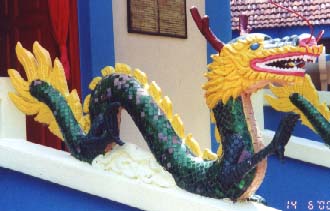
[full size] At a temple I went to in Penang.
Elemental Dragon Types
Dragons also appear in Chinese Astrology. It appears fifth in the 12-year cycle of animals in the Chinese Zodiac.
The traits of each elemental Dragon-type are as follows.
ASTROLOGY – THE YEAR OF THE DRAGON
1904 – Wood Dragon
1916 – Fire Dragon
1928 – Earth Dragon
1940 – Metal dragon
1952 – Water dragon
1964 – Wood Dragon
1976 – Fire Dragon
1988 – Earth Dragon
2000 – Metal Dragon
2012 – Water Dragon
WOOD DRAGON: The Wood Dragon is creative, imaginative, and inquisitive. He is both a thinker and a doer and is capable of brilliant new concepts. Every move is guided by sound logic. His drive and ambition allow him to put many of his ideas into practice. Nevertheless this Dragon is capable of concealing his domination and tries not to offend. He will even compromise if it is advantageous. Although not as self-centered as other Dragons, he is still outspoken and fearless when challenged.
FIRE DRAGON: The Fire Dragon is the most extroverted and competitive Dragon. He tends to push too hard and expects a lot from everyone. His criticisms are objective and he has the ability to arouse massive popular support. His insatiable ambition can make him short-tempered and intolerant. He is an empire builder who needs to master his less favorable traits and learn how to communicate more humbly with people as individuals.
EARTH DRAGON: The Earth Dragon is a quieter, more reflective Dragon. She will be appreciative of others’ opinions even if she fails to agree with them. She is reasonable in her approach to problems and her leadership is less dictatorial. She is not given to outbursts of temper, but at the same time demands respect. She knows the value of cooperation and is more diplomatic than the other Dragons. She’s ambitious, but her initiatives are more carefully thought out.
WATER DRAGON: The Water Dragon is less selfish and opinionated than the other Dragons. She is more inhibited and less power-hungry. She can accept defeat without recriminations. She makes a good negotiator as she knows when, where, and how to apply pressure. She has a tendency to be over-optimistic and needs to learn how to relinquish what is unfeasible so she can concentrate her energies on the most rewarding endeavors.
METAL DRAGON: Metal Dragons are the most strong-willed Dragon. They’re inflexible, unbending, and combative. They can give little regard to the feelings of others. This ruthlessness can result in a rapid rise to a position of authority, but often at the cost of destroying important relationships. They will go their own way if they can’t gain support. They succeed because they refuse to accept failure. The Metal element also represents purity and precision.
THE DRAGON – Personality Traits
Dragon people are self confident and impulsive and consequently does not always listen to the advice of others. They are also perfectionists and set high standards for themselves.
Although strong and decisive the Dragon person is not manipulative or sly. They enjoy being in command and like an emperor holding court, they eliminate obstacles until success is theirs!
FAMOUS DRAGON PEOPLE
Famous Dragon People include Ringo Starr, Dr. Seuss, John Lennon, Helen Keller, Salvador Dali, Susan B. Anthony, Joan of Arc, Orlando Bloom, Sigmund Freud, John Lennon, Florence Nightingale, Keanu Reeves, Ronaldo, and Mae West.
Long Live Dragons..
Dragons are an important part of Chinese culture and mythology. They are the dragons with the most recorded history in the world. Today, spectacular dragon dances are still celebrated (especially during Chinese New Year) in parades around the world.

Welcoming the Matsu’s array with a dragon dance, Taiwan. © dans.photos
The dragons in the East have been seen as friendly and helpful creatures. They have proved to remain a symbol of strength, good fortune, wisdom and longevity.
References:
Books:
Dragons: A Natural History – Dr. Karl Shuker
Websites:
>Chinavoc.com >DRAGON’S BONES AND TEETH >Dragons Unlimited >Asian Ideas > Dragons & Dragon Lore > The Serene Dragon
Famous Chinese Dragons
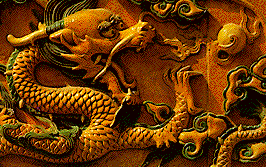
[full size]: the Flaming Pearl sought by the Dragon Palace Museum Peking, by Weng and Boda (Abrams 1982)
Dragon of Kinabalu
– The dragon of Kinabalu had a pearl which the emperor wanted. He sent his two sons, Wee Ping and Wee San, to get it for him after his men perished in their efforts. Wee San flew into the dragon’s cave by a kite while it was out hunting. There he switched the pearl for a fake. Of course, the dragon knew it wasn’t his pearl, and made chase for the brother’s ships. Again it was Wee San who came up with the plan.
He ordered his men to shoot a cannon ball at the dragon, and when they did the dragon, thinking it was its pearl, swallowed the cannon. It died immediately. When they returned home, Wee Ping decided to take the credit for everything. Wee San was a good man and decided it wasn’t worth losing his family over. He went into self-imposed exile and was prosperous. He was made the ruler of Brunei, living a happy life. His brother, however, was never to know true happiness.
Yellow Dragon
– Yellow dragon or dragon horse was the divine messenger that arose from the River Lo and revealed the 8 trigrams of I Ching. A yellow dragon is said to have presented the Chinese with a scroll inscribed with mystic characters. This is said to be the legendary origin of the Chinese system of writing.
lung wang
– lung wang was a human-bodied fire dragon, an immortal dragon king living in a palace under the sea.
Thunder Dragon
– the Thunder Dragon could transform into a boy with bright ultramarine skin who rode a scarlet carp.
t’ao t’ieh

t’ao t’ieh bronze mask, Shang Dynasty
– t’ao t’ieh has one head and two forelegs, but has two bodies with separate hind legs and tails. It personifies gluttony. It is pictured on dishes to discourage greed and is commonly used by artists because of its symmetry.
yu lung
– yu lung is the fish dragon symbolising success in exams
Winding Dragon
– Xia Dynasty’s dragon totem. Scholar Gao Wei pointed out that the coloured Pottery from Taosi Excavations of Longshan Culture, dated 2400-2500 BC approx, had shown a winding dragon.
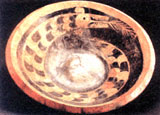
[full size]: Winding dragon on coloured pottery
Almost all Taosi excavations in southern Shanxi Prov had produced pottery with a dragon totem. Chinese classics had mentioned two dragon-related clans, i.e., the Huan-long-shi clan during Lord Shun’s reign and the Yu-long-shi clan during Xia Dynasty. Xia people, who later moved from Shanxi to Henan Prov and founded the dynasty of Xia, certainly brought with them the important dragon totem, a mark that would also be observed among the Huns of Mongolia and the Tungus of Manchuria for the thousands of years to come.
References:
> Information on Oriental Dragons